

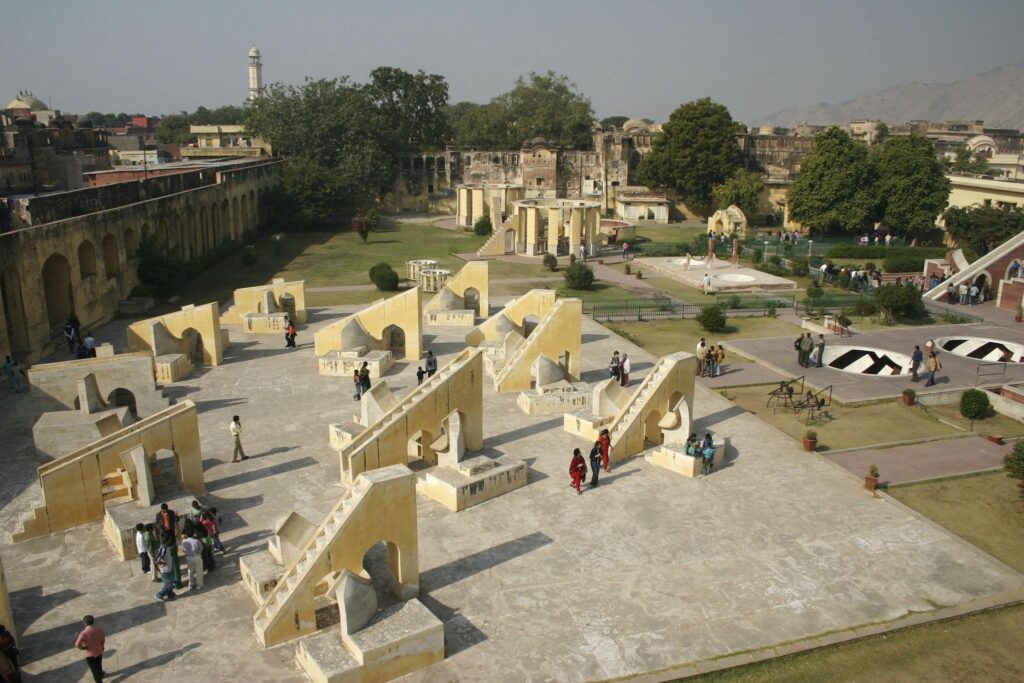
Not every monument tells a story of kings, battles, or royal palaces.
Some tell the story of science.
In the heart of Jaipur, just steps away from the City Palace, stands Jantar Mantar, one of the most extraordinary astronomical observatories ever built.
At first glance, the massive stone structures may look like modern art installations. But each instrument was carefully designed over 300 years ago to study the movement of the sun, planets, and stars with remarkable accuracy.
Today, Jantar Mantar is one of Jaipur’s most unique attractions and a must-visit destination for travelers interested in history, astronomy, and architecture.
The Vision of a Scholar King
The observatory was commissioned by Sawai Jai Singh II in the early 18th century.
Unlike many rulers of his time, Jai Singh was deeply interested in astronomy and mathematics. He noticed inaccuracies in existing astronomical tables and decided to create a series of observatories across India.
Jaipur’s Jantar Mantar became the largest and most sophisticated of them all.
Completed around 1734, the observatory helped astronomers measure time, predict eclipses, track celestial bodies, and study the movements of the heavens.
A UNESCO World Heritage Site
Because of its historical and scientific importance, Jantar Mantar was designated a UNESCO World Heritage Site in 2010.
It remains one of the best-preserved astronomical observatories in the world and continues to attract visitors from every corner of the globe.
More Than Just a Collection of Instruments
The observatory contains 19 large astronomical instruments, each serving a specific purpose.
These structures were designed to:
- Measure time accurately
- Track planetary positions
- Observe constellations
- Predict eclipses
- Determine celestial coordinates
- Study seasonal changes
What makes them remarkable is that they achieve impressive precision without the use of modern technology.
The World’s Largest Stone Sundial
The most famous structure inside Jantar Mantar is the Samrat Yantra.
Its enormous triangular shape dominates the complex and functions as a giant sundial.
The instrument can measure time with astonishing accuracy, often within a few seconds.
For many visitors, standing beside the Samrat Yantra is the highlight of the entire observatory.
Fascinating Instruments to Discover
Samrat Yantra
The world’s largest stone sundial and the centerpiece of the observatory.
Jai Prakash Yantra
A unique instrument designed to observe celestial positions and study astronomical coordinates.
Rama Yantra
Used to measure the altitude and direction of celestial objects.
Narivalaya Yantra
An instrument specifically designed to track the movement of the sun.
Together, these instruments demonstrate the scientific achievements of 18th-century India.
Why Travelers Love Jantar Mantar
Unlike traditional forts and palaces, Jantar Mantar offers a completely different experience.
Visitors enjoy:
- Unique architecture
- Interactive learning opportunities
- UNESCO World Heritage status
- Fascinating scientific history
- Excellent photography locations
- Central location in Jaipur
It is one of the few places where science, history, and architecture blend seamlessly.
Best Time to Visit
The ideal time to visit Jantar Mantar is between October and March when Jaipur enjoys pleasant weather.
For the best experience:
- Visit in the morning.
- Hire a guide to understand the instruments.
- Combine your visit with nearby attractions.
- Avoid peak afternoon heat during summer.
Timings
| Information | Details |
|---|---|
| Opening Time | 9:00 AM |
| Closing Time | 5:00 PM |
| Open Days | Every Day |
Visitors generally spend 1 to 2 hours exploring the observatory.
Ticket Information
| Visitor Type | Approximate Fee |
|---|---|
| Indian Visitors | ₹50–₹100 |
| Foreign Visitors | ₹200–₹250 |
| Students | Concessions may apply |
Ticket prices are subject to change.
Nearby Attractions
One of the biggest advantages of visiting Jantar Mantar is its location in Jaipur’s historic center.
Nearby attractions include:
- City Palace Jaipur
- Hawa Mahal
- Albert Hall Museum
- Jal Mahal
These sites can easily be visited in a single day.
Travel Tips
- Hire a local guide for a better understanding of the instruments.
- Visit during the morning for comfortable weather.
- Carry water during warmer months.
- Wear comfortable footwear.
- Bring a camera for unique architectural photographs.
Final Thoughts
Jantar Mantar is not just a tourist attraction—it’s a celebration of human curiosity and scientific achievement.
More than 300 years after its construction, the observatory continues to inspire visitors with its innovative design and remarkable accuracy. Whether you’re passionate about astronomy or simply looking for something different during your Jaipur visit, Jantar Mantar offers an experience unlike any other in India.