

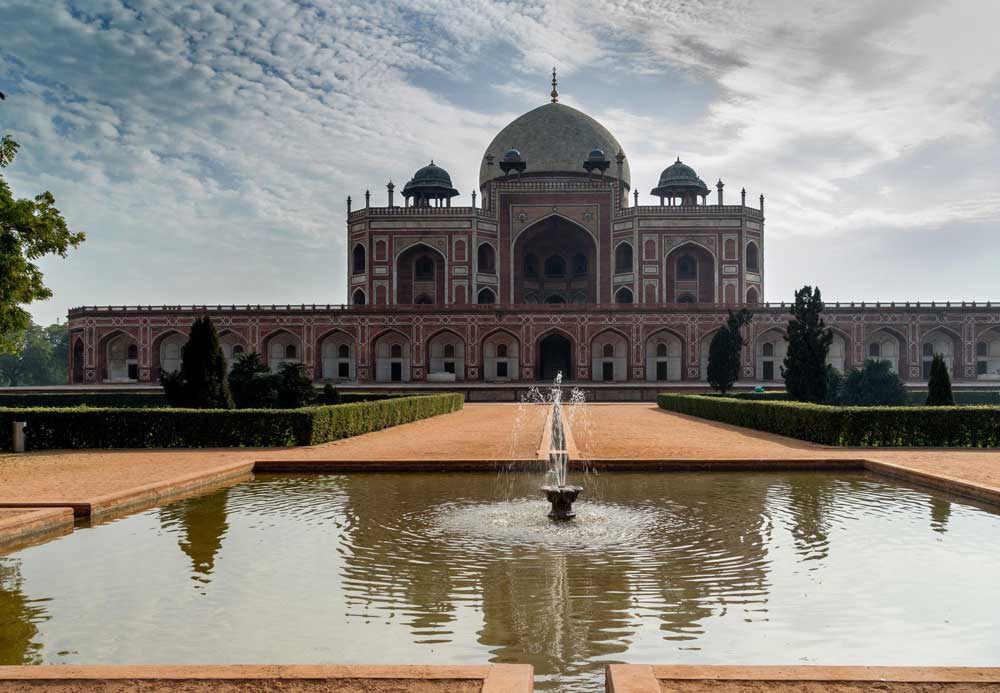
Long before the Taj Mahal became India’s most famous monument, there was another architectural wonder that changed the course of Mughal architecture forever—Humayun’s Tomb.
Nestled amidst beautifully landscaped gardens in Delhi, this UNESCO World Heritage Site is the final resting place of Emperor Humayun and is widely regarded as the first grand garden tomb in the Indian subcontinent.
With its stunning symmetry, red sandstone façade, and Persian-inspired design, Humayun’s Tomb is often described as the architectural predecessor of the Taj Mahal.
The Story Behind Humayun’s Tomb
The tomb was commissioned in 1565 by Empress Bega Begum, also known as Haji Begum, in memory of her husband, Emperor Humayun.
Designed by Persian architect Mirak Mirza Ghiyas, the monument was completed around 1572 and became the first major example of Mughal architecture in India.
Its innovative design later inspired several Mughal monuments, including the world-famous Taj Mahal.
Why Humayun’s Tomb is So Important
Humayun’s Tomb holds a special place in Indian history because it introduced architectural elements that would later define Mughal monuments.
Its significance includes:
- First grand Mughal garden tomb in India
- UNESCO World Heritage Site
- Inspiration for the Taj Mahal
- Outstanding example of Persian and Mughal architecture
- Final resting place of several Mughal royals
Today, it remains one of Delhi’s most visited heritage attractions.
Architecture That Changed History
Humayun’s Tomb is a masterpiece of symmetry and design.
The monument combines Persian architectural concepts with Indian craftsmanship, creating a style that became the hallmark of Mughal architecture.
Highlights include:
- Magnificent red sandstone structure
- White marble domes and detailing
- Charbagh-style Mughal gardens
- Elegant arches and gateways
- Geometric patterns and decorative carvings
- Perfectly symmetrical layout
The tomb stands at the center of a vast garden divided into four sections by water channels, symbolizing the Islamic concept of paradise.
Exploring the Humayun’s Tomb Complex
The complex contains several fascinating structures beyond the main mausoleum.
Main Tomb of Humayun
The centerpiece of the complex houses the cenotaph of Emperor Humayun and showcases the finest elements of early Mughal architecture.
Isa Khan’s Tomb
Built before Humayun’s Tomb, this octagonal structure belongs to the Afghan noble Isa Khan and features beautiful garden surroundings.
Barber’s Tomb
A smaller but historically significant monument located within the complex.
Nila Gumbad
Known as the Blue Dome, this structure is famous for its distinctive blue tile work.
Arab Serai
A historic enclosure built to house artisans and workers involved in constructing the tomb.
Best Time to Visit Humayun’s Tomb
Humayun’s Tomb can be visited throughout the year, but the most pleasant months are from October to March.
For the best experience:
- Visit early in the morning.
- Explore during weekdays for fewer crowds.
- Arrive near sunset for beautiful photography.
- Winter months provide comfortable weather for sightseeing.
Humayun’s Tomb Timings
| Information | Details |
|---|---|
| Opening Time | Sunrise |
| Closing Time | Sunset |
| Open Days | Every Day |
Humayun’s Tomb Ticket Price
| Visitor Type | Ticket Price |
|---|---|
| Indian Citizens | Approx. ₹40 |
| Foreign Tourists | Approx. ₹600 |
| Children Below 15 Years | Free |
Ticket rates may change, so checking current prices before your visit is recommended.
Interesting Facts About Humayun’s Tomb
- It was the first garden tomb in India.
- It inspired the design of the Taj Mahal.
- More than 150 Mughal family members are buried within the complex.
- It became a UNESCO World Heritage Site in 1993.
- The monument underwent extensive restoration to preserve its original beauty.
Nearby Attractions
After visiting Humayun’s Tomb, travelers can easily explore other famous landmarks in Delhi:
- India Gate
- Qutub Minar
- Lotus Temple
- Red Fort
Travel Tips for Visitors
- Wear comfortable walking shoes.
- Carry water during warmer months.
- Visit early to avoid crowds.
- Bring a camera for photography.
- Hire a guide to learn the monument’s fascinating history.
- Spend at least 1.5–2 hours exploring the complex.
Final Thoughts
Humayun’s Tomb is more than just a burial monument—it is the foundation of Mughal architecture in India. Its stunning gardens, elegant design, and historical significance make it one of Delhi’s most rewarding heritage sites.
For travelers interested in history, architecture, and photography, Humayun’s Tomb offers an unforgettable glimpse into the grandeur of the Mughal era and the origins of the architectural style that eventually gave the world the Taj Mahal.
Planning a Delhi or Golden Triangle tour?
Visit:
Visit India With Guide